
The real problem with Bring Your Own Device (BYOD) policies is not that employees use their personal devices for work. It’s that many enterprises adopted a mobile-first operating model while relying on security approaches that were never designed for how modern mobile environments actually function.
Over the last decade, smartphones evolved from secondary communication devices into central business tools. Employees now use mobile devices to access cloud applications, join meetings, communicate with customers and coworkers, approve MFA requests, review sensitive documents, and maintain persistent access to enterprise systems throughout the day.
Hybrid work accelerated this shift even further by reinforcing the expectation that work should happen from anywhere, at any time, on whatever device employees already use most comfortably.
For organizations, BYOD also introduced practical advantages. It reduced hardware costs, simplified remote work adoption, and allowed employees to remain productive without depending entirely on company-issued devices. As a result, BYOD became less of a policy exception and more of an operating reality. But many security programs never fully adapted to that reality.
Why Traditional BYOD Security Models Struggled
Employees in BYOD environments are understandably uncomfortable with aggressive monitoring on devices that contain personal messages, banking applications, family information, private communications, and location history.
Enterprise mobile security programs built around extensive device monitoring, intrusive management policies, full-device inspection, restrictive controls, or mobile VPN routing often introduced privacy concerns, battery drain, performance issues, usability friction, and employee distrust.
In many cases, employees resisted enrollment, disengaged from controls, or avoided bringing personal devices into managed programs altogether. The result was a persistent tension between enterprise visibility and employee privacy.
That tension has shaped the way many organizations think about BYOD security. Too often, they assume they must either accept limited visibility in order to preserve privacy, or accept invasive controls in order to reduce risk.
That is the wrong tradeoff.
The False Choice Between Privacy and Security
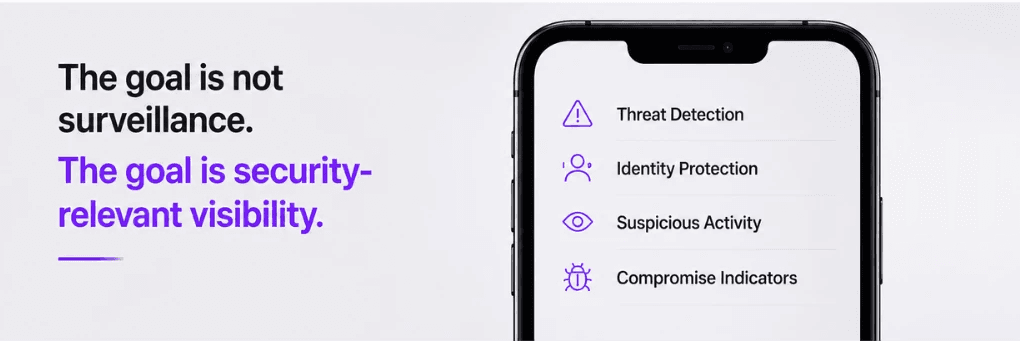
What organizations actually need is not broad visibility into everything happening on a personal device. They need security-relevant visibility into indicators associated with compromise, identity abuse, suspicious behavior, and threats that could affect enterprise access.
That includes signals related to malicious authentication activity, suspicious mobile communications, indicators of exploitation, abnormal access behavior, identity compromise attempts, and mobile threat telemetry relevant to enterprise risk.
The goal should not be surveillance of personal devices, but understanding whether a device used for trusted enterprise access is showing signs of compromise or malicious activity.
This is where privacy-first Mobile EDR becomes important. Unlike approaches that rely on invasive management or broad personal data collection, privacy-first Mobile EDR is designed to detect real mobile threats while limiting visibility to the security signals organizations actually need.
iVerify Enterprise was built around this principle, helping organizations identify mobile threats, device compromise, smishing activity, and suspicious behavior across iOS and Android without requiring security teams to broadly inspect personal content or turn BYOD into an invasive monitoring program.
For BYOD environments, that distinction matters. Security teams need confidence that the devices accessing enterprise systems can be trusted. Employees need confidence that protecting work data does not mean exposing their personal lives.
That trust is not a soft requirement. If employees resist enrollment, disable protections, avoid reporting suspicious activity, or look for workarounds, organizations lose visibility precisely where they need it most.
Modern BYOD Security Requires a Different Approach
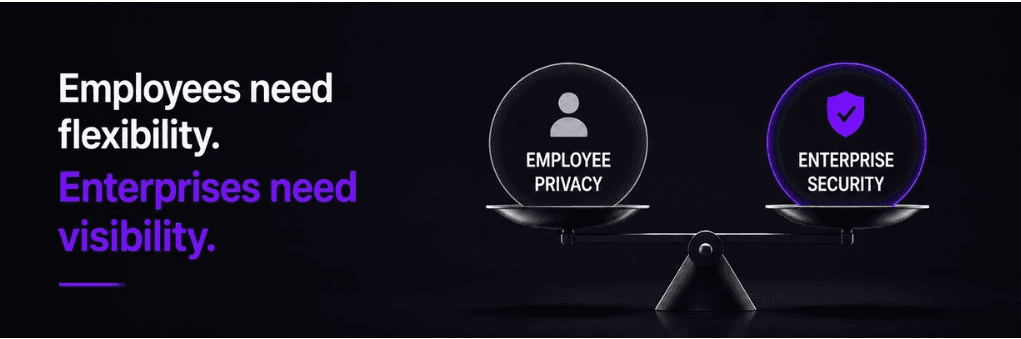
Effective BYOD protection requires moving beyond the assumption that device management alone is sufficient. It also requires moving beyond overly invasive approaches that undermine employee trust and create operational friction.
Modern BYOD security strategies increasingly need to focus on:
threat visibility
compromise detection
behavioral analysis
identity-aware security
privacy-conscious telemetry
continuous verification of trusted access
This is the gap privacy-first Mobile EDR is designed to address. By focusing on security-relevant signals instead of personal surveillance, platforms like iVerify Enterprise help organizations strengthen mobile threat detection while preserving the trust BYOD programs depend on.
Most importantly, organizations need to recognize that BYOD itself is not the underlying problem. The real issue is that many enterprises still operate with limited visibility into the devices employees use every day to authenticate into critical systems, communicate sensitive information, and access corporate data.
Attackers already understand how valuable those devices have become. Enterprise security strategies now need to catch up.


Subscribe to our blog to receive the latest research and industry trends delivered straight to your inbox. Our blog content covers sophisticated mobile threats, unpatched vulnerabilities, smishing, and the latest industry news to keep you informed and secure.