
Most enterprise security programs are built around a familiar assumption: if the device is healthy, enrolled, patched, and compliant, then the risk is manageable.
That assumption works for a lot of mobile threats. If a device is jailbroken, rooted, infected with malware, running risky applications, or communicating with suspicious infrastructure, there are signals a security team can look for. MTD and mobile EDR tools are typically designed around those kinds of device-level indicators.
SIM swapping is different.
In a SIM swap attack, the attacker does not necessarily need to compromise the physical device at all. Instead, they target the phone number associated with the user. If they can convince or manipulate a carrier into transferring that number to a SIM or eSIM they control, they can begin receiving the victim’s SMS messages, voice calls, and account recovery codes on another device.
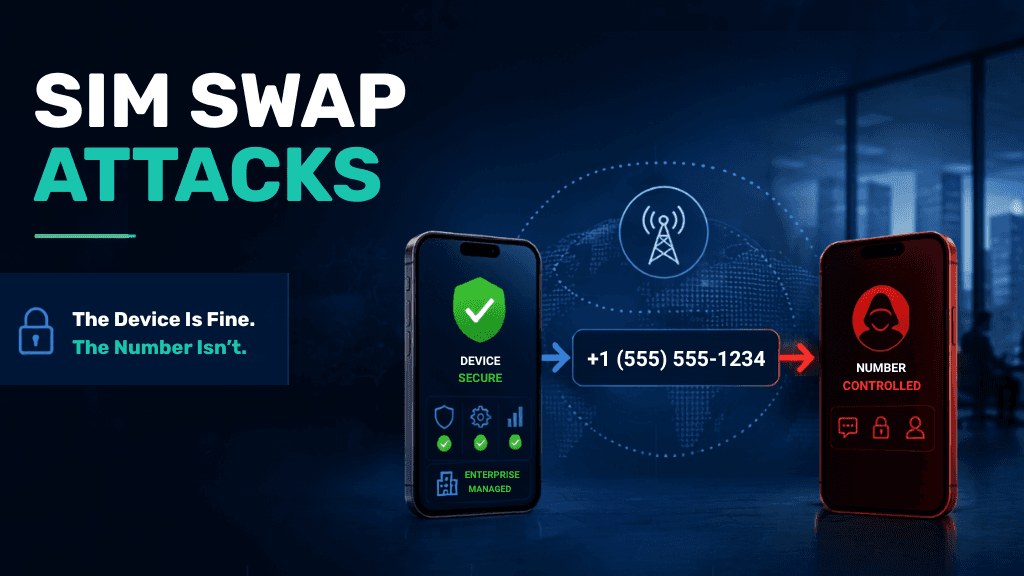
From the enterprise’s perspective, this creates a difficult visibility gap. The employee’s original device may still look completely normal. It may still be enrolled in MDM. It may still pass compliance checks. It may still be patched. But the phone number tied to that user’s identity may no longer be under their control.
That is the important distinction: SIM swapping is not always a compromise of the device. It is a compromise of the phone number as an identity factor.
The Device Can Be Clean While the Number Is Compromised
Most enterprise mobile security controls are designed to answer device-centric questions.
Is the device enrolled?
Is it compliant?
Is it jailbroken or rooted?
Is there malware present?
Are risky applications installed?
Is the device communicating with suspicious network infrastructure?
Those are important questions, but they do not answer a different and increasingly important one: does the user still control the phone number associated with this device?
That question matters because phone numbers are still deeply embedded in enterprise identity workflows. Even in organizations moving toward phishing-resistant MFA, phone numbers often remain present in SMS-based one-time passcodes, voice-based verification, password resets, help desk workflows, account recovery flows, and step-up authentication.
A SIM swap attack takes advantage of that dependency. The attacker’s goal is not necessarily to infect the device. The goal is to gain control of the number and use it to intercept the messages or calls that other systems still trust.
That is why a SIM swap can bypass controls that are focused only on device integrity. A clean device does not prove that the user still controls the phone number. A compliant device does not prove that SMS-based authentication is safe. An enrolled device does not prove that account recovery messages are going to the right person.
In practice, this means a SOC may have no obvious device compromise to investigate, even while an attacker is actively receiving authentication codes on a separate device.
Why Traditional Mobile Security Misses the Signal
Traditional mobile security tools were not originally designed to validate phone number ownership.
MDM can tell an organization whether a device is enrolled, whether it meets policy requirements, and in some cases whether a SIM is present. Mobile threat defense can identify device compromise, malicious applications, unsafe configurations, or suspicious network activity. Mobile EDR can provide deeper visibility into device behavior and threat signals.
But SIM swapping lives in a different layer.
The attacker may not need to alter the device. They may not need to install an app. They may not need to jailbreak or root anything. They may not need to generate suspicious traffic from the victim’s phone.
Instead, the number is moved at the carrier level.
That means many conventional signals will look normal. The device may continue to function over Wi-Fi. Messaging apps may still work. Corporate apps may still be accessible. The user may not immediately notice that cellular service has changed, especially if they are in an environment where Wi-Fi calling or app-based communications mask the disruption.
This is why relying only on user awareness or standard device posture can be too slow. By the time the user realizes they have lost service, the attacker may already have attempted password resets, MFA bypass, or account recovery against high-value systems.
To be clear, device security still matters. Organizations still need to detect malware, risky applications, OS compromise, smishing, and other mobile threats. But SIM swap detection requires a different signal because the attack targets a different control point: the phone number.
Why SIM Presence Is Not Enough
One of the challenges with SIM swap detection is that some surface-level indicators can be misleading.
A SIM swap can leave the original SIM or eSIM physically present. In some cases, the device may still have a connection, or retain connectivity over Wi-Fi. But the number the organization trusts may already have been transferred somewhere else.
That makes SIM presence a weak proxy for phone number integrity.
This distinction matters for enterprise security teams because many authentication and recovery workflows are tied to the number, not to the physical SIM card in the user’s hand. If the number moves, the trust relationship changes, even if the device itself still appears normal.
Why SMS Heartbeats Create Noise
Another approach some organizations use is an SMS heartbeat. The idea is straightforward: send a message to the user’s number on a schedule. If the message stops being delivered, treat that as a potential SIM swap indicator.
The problem is that SMS delivery can fail for many reasons that have nothing to do with an attack.
A user may be roaming. They may be temporarily out of coverage. A carrier may experience delays. A device may have intermittent connectivity. Delivery may be unreliable for reasons that are operational rather than malicious.
That creates noise.
For a SOC, noisy signals are a real problem. If analysts see too many alerts that do not require action, they begin to tune them out. Over time, the real signal can get buried under false positive volume.
SMS heartbeats can also add operational cost and complexity because they require recurring message delivery at scale. For large enterprise fleets, that is not a trivial consideration.
The deeper issue is that SMS heartbeat failure is still an indirect signal. It tells you that a message may not have been delivered. It does not authoritatively confirm that the phone number has been transferred to another SIM.
For SIM swap detection to be useful in enterprise workflows, the signal needs to be higher confidence than that.
Why User Self-Reporting Is Too Slow
Some organizations rely on the user to report the problem.
The user loses cellular service, notices something is wrong, contacts IT, and then the organization begins investigating. That is not a reliable detection model for a time-sensitive attack.
First, users may not notice right away. Many employees spend most of the day connected to Wi-Fi. They may continue using email, collaboration tools, messaging apps, and corporate applications without realizing that their cellular line has been affected.
Second, the attacker’s window of opportunity may be short. Once they control the phone number, they can attempt to reset passwords, intercept one-time passcodes, hijack recovery flows, or impersonate the user in help desk workflows. The value of the attack comes from acting before the victim or organization realizes what happened.
Third, user reporting does not scale as a security control. It depends on awareness, timing, and behavior. In enterprise environments, especially for high-risk users, that is not enough.
A security team should not have to wait for an employee to notice that something feels wrong before it receives a signal that a trusted identity factor may be compromised.
Why Carrier Confirmation Matters
The carrier is the authoritative source for whether a phone number has been transferred to a different SIM or eSIM, which is why carrier confirmation is so important for SIM swap detection.
Device telemetry can provide useful signals that something may have changed. But no single device-level field should be treated as conclusive on its own. Individual signals can have benign explanations. Network state can change. Carrier behavior can vary. Coverage and roaming conditions can affect what the device reports.
The more reliable approach is to use device telemetry as the trigger, then validate the suspected event with the carrier.
That is the model iVerify Enterprise uses.
iVerify SIM Swap Detection passively samples cellular state from OS-exposed telephony APIs on the device. Those signals are evaluated for recognizable SIM swap patterns. Importantly, iVerify Enterprise does not alert on a single field in isolation. The detection looks for a combination of changes that together create a fingerprint of potential SIM swap activity.
When that pattern is detected and the phone number is available, iVerify queries the relevant carrier to confirm whether the SIM-to-IMSI binding has changed within a recent window. IMSI, or International Mobile Subscriber Identity, is the globally unique identifier stored on a SIM that identifies a mobile subscriber to the cellular network.
If the carrier confirms the change, iVerify Enterprise generates an alert for the security team.
That combination matters. Device telemetry provides context from the managed endpoint. Carrier confirmation validates whether the number has actually been moved. Together, they give SOC teams a higher-confidence signal than SMS heartbeat failure, SIM presence, or user self-reporting alone.
What This Changes for Enterprise Security Teams
The practical value of SIM swap detection is not just knowing that a swap happened. It is knowing quickly enough to respond before phone number control becomes account control.
Once a SIM swap is confirmed, security teams can take action. They can suspend active sessions. They can reset MFA factors. They can review password reset attempts. They can lock high-value workflows. They can escalate to identity, help desk, or incident response teams. They can apply additional scrutiny to executive, administrator, or finance accounts tied to the affected number.
This is especially important for organizations that still use SMS or voice-based verification anywhere in the environment.
To be clear, SIM swap detection does not replace phishing-resistant MFA. Security teams should continue moving toward stronger authentication methods wherever possible. But in the real world, many organizations still have SMS or voice-based workflows embedded in legacy systems, recovery processes, help desk procedures, or third-party applications.
SIM swap detection gives those organizations a safety net. It helps identify when a phone number has become unsafe as an identity factor, so the organization can act before an attacker uses that number to compromise additional accounts.
Closing the Visibility Gap
SIM swapping bypasses enterprise security measures because it does not always attack the thing those measures are watching.
The device may be fine.
The phone number may not be.
That is the visibility gap security teams need to close.
A mobile security program that only evaluates device posture can miss identity-factor compromise. A user-reporting model can be too slow. SMS heartbeat checks can be too noisy. SIM presence alone can be misleading.
Enterprise teams need a way to detect when the phone number associated with a managed device has been transferred away from the legitimate user. And they need that signal to be high confidence, timely, and actionable for the SOC.
iVerify SIM Swap Detection is built for that use case. It combines passive on-device telemetry with carrier confirmation to help security teams detect SIM swap activity without SMS heartbeats, user prompts, or additional end-user permissions.
For organizations that rely on mobile devices as part of identity and access workflows, that visibility is increasingly important.
To learn more about how iVerify Enterprise helps security teams detect carrier-confirmed SIM swap activity across managed mobile fleets, book a demo.


Subscribe to our blog to receive the latest research and industry trends delivered straight to your inbox. Our blog content covers sophisticated mobile threats, unpatched vulnerabilities, smishing, and the latest industry news to keep you informed and secure.