
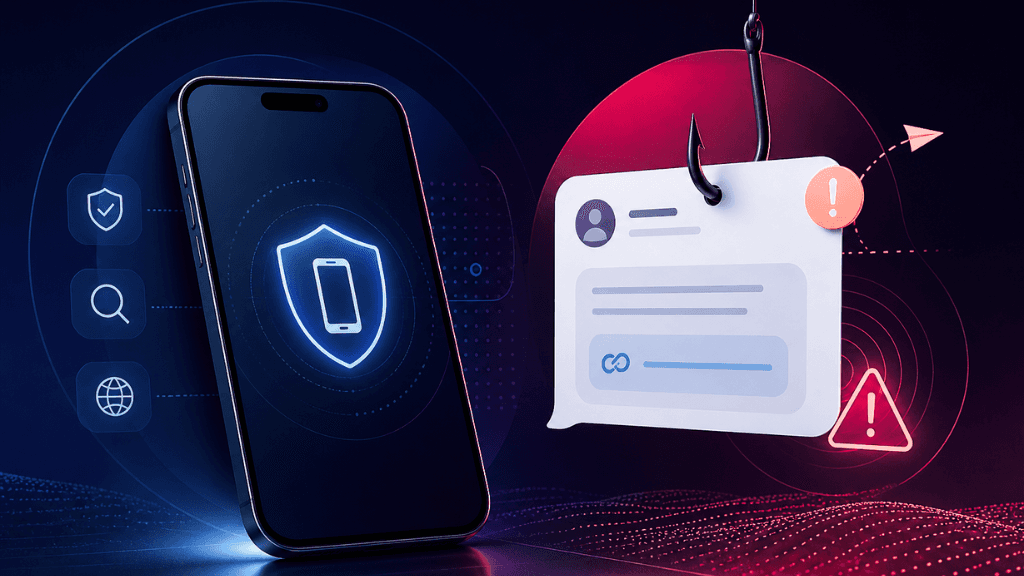
Mobile EDR has become an important part of the enterprise security stack, bringing visibility to a class of threats that traditional mobile threat detection (MTD) tools were never designed to detect. It treats mobile devices as endpoints, not just managed assets, and in many cases, it’s the first step organizations take toward closing the mobile security gap.
But when it comes to smishing, mobile EDR alone is not enough. Not because the category is flawed, but because most implementations were not built to handle how these attacks actually work.
Most Mobile EDR Approaches Focus on the Wrong Signal
If you look at how most mobile security tools approach smishing, you'll see they tend to focus on one thing: links.
That makes sense on the surface. A large portion of attacks do include URLs, and there are well-established techniques for analyzing them. Domain reputation, age, redirection behavior, brand impersonation; these signals are useful, and they can stop a meaningful percentage of threats. But they only address one class of smishing.
In practice, there are two distinct types of attacks:
Messages that contain URLs
Messages that do not
The industry has focused heavily on the first. Attackers have adapted to the second.
The Rise of URL-Less Smishing
Some of the most effective smishing campaigns today don’t include a link at all.
They start with something deliberately simple. A single message from an unknown number. Sometimes just one word.
“Hello.”
The goal is not to deliver a payload immediately. It’s to initiate interaction.
Once the user responds, the attacker has achieved something important. The conversation moves from an unknown sender to a known one. At that point, both the operating system and most security tools lose visibility into what happens next.
From there, the attack can evolve:
Impersonation of an executive or colleague
Requests for credentials or sensitive actions
Escalation into a voice call (vishing)
None of this involves a URL. And none of it is detectable through traditional link analysis.
This is where most mobile EDR approaches fall short, and it’s one of the most common concerns I hear from enterprise security teams.
Detection Has to Happen Before the User Engages
One of the key challenges with smishing is timing.
If detection happens after the user has already interacted with the message, it’s often too late. The attack has already moved into a channel that is no longer observable.
That means detection has to happen at the very first message, not based on known indicators alone, but based on intent.
Is the message creating urgency?
Is it trying to trigger a quick decision?
Is it impersonating a trusted entity?
These are the signals that determine whether an attack is likely to succeed. And they are fundamentally different from the signals most tools are designed to analyze.
Smishing Doesn’t Stay in One Channel
Another limitation in most mobile EDR approaches is that they treat smishing as an isolated event when in reality, it’s often the beginning of a multi-step attack.
A message leads to a conversation –> The conversation leads to a phone call –> The phone call leads to credential compromise.
We see this pattern consistently. The same numbers used in smishing campaigns are often reused in follow-on vishing attacks. That continuity is part of how attackers maintain trust and control the interaction.
If your detection strategy ends at identifying a suspicious message, you’re missing the rest of the attack chain.
To be effective, controls need to extend beyond the message itself:
Blocking known malicious numbers
Preventing outbound calls to those numbers
Intervening across both messaging and voice channels
Without that feedback loop, the attacker still has a path forward.
Why This Matters for Enterprise Risk
Smishing is not just a nuisance. It’s an entry point into identity-driven attacks.
Once a user is engaged, the attacker doesn’t need to exploit the device. They can operate entirely within legitimate workflows:
MFA prompts
Password resets
Help desk impersonation
Session token capture
These are attacks that bypass traditional endpoint protections because they don’t rely on malware, they rely on interaction.
That’s why treating smishing as a subset of mobile malware or URL filtering is insufficient. It’s a different problem, and it needs to be addressed as one.
What a More Complete Approach Looks Like
To effectively address smishing, mobile security needs to go beyond traditional EDR capabilities. At a minimum, that means:
Detecting both URL-based and non-URL attacks
Analyzing message intent, not just indicators
Intervening before user interaction occurs
Extending protection across messaging and voice channels
Continuously learning from evolving attack patterns
These are not incremental improvements. They represent a shift in how smishing needs to be handled at the enterprise level.
Introducing SmishGuard: Advanced Smishing Protection from iVerify Enterprise
This post has outlined the advanced capabilities necessary to truly address modern smishing attacks. SmishGuard is the solution that delivers this complete approach.
For organizations looking to future-proof their security stack, SmishGuard is the critical add-on that closes the gaps in visibility, timing, and multi-channel coverage left by traditional tools. At iVerify, SmishGuard is a core feature of our Enterprise Mobile EDR platform, built specifically to address this evolving threat vector. It is designed to intervene before user interaction occurs, extending protection across messaging and voice channels, and continuously learning from the latest attack patterns.
SmishGuard uniquely addresses both URL-based and non-URL attacks by analyzing message intent—the urgency, impersonation attempts, and social engineering cues—instead of relying solely on link indicators. It is built with a privacy-first architecture, meaning messages from unknown senders are analyzed through a privacy-preserving cloud pipeline that cannot identify the originating device or recipient. Messages confirmed as safe are not retained. (Learn more about how SmishGuard preserves user privacy.) By shifting detection to the very first message, we eliminate the attacker's ability to escalate the interaction into unobservable channels like voice calls (vishing) or legitimate identity workflows.
If your current mobile security strategy is falling short against URL-less or multi-channel smishing and vishing attacks, it’s time to see the SmishGuard difference.


Subscribe to our blog to receive the latest research and industry trends delivered straight to your inbox. Our blog content covers sophisticated mobile threats, unpatched vulnerabilities, smishing, and the latest industry news to keep you informed and secure.