
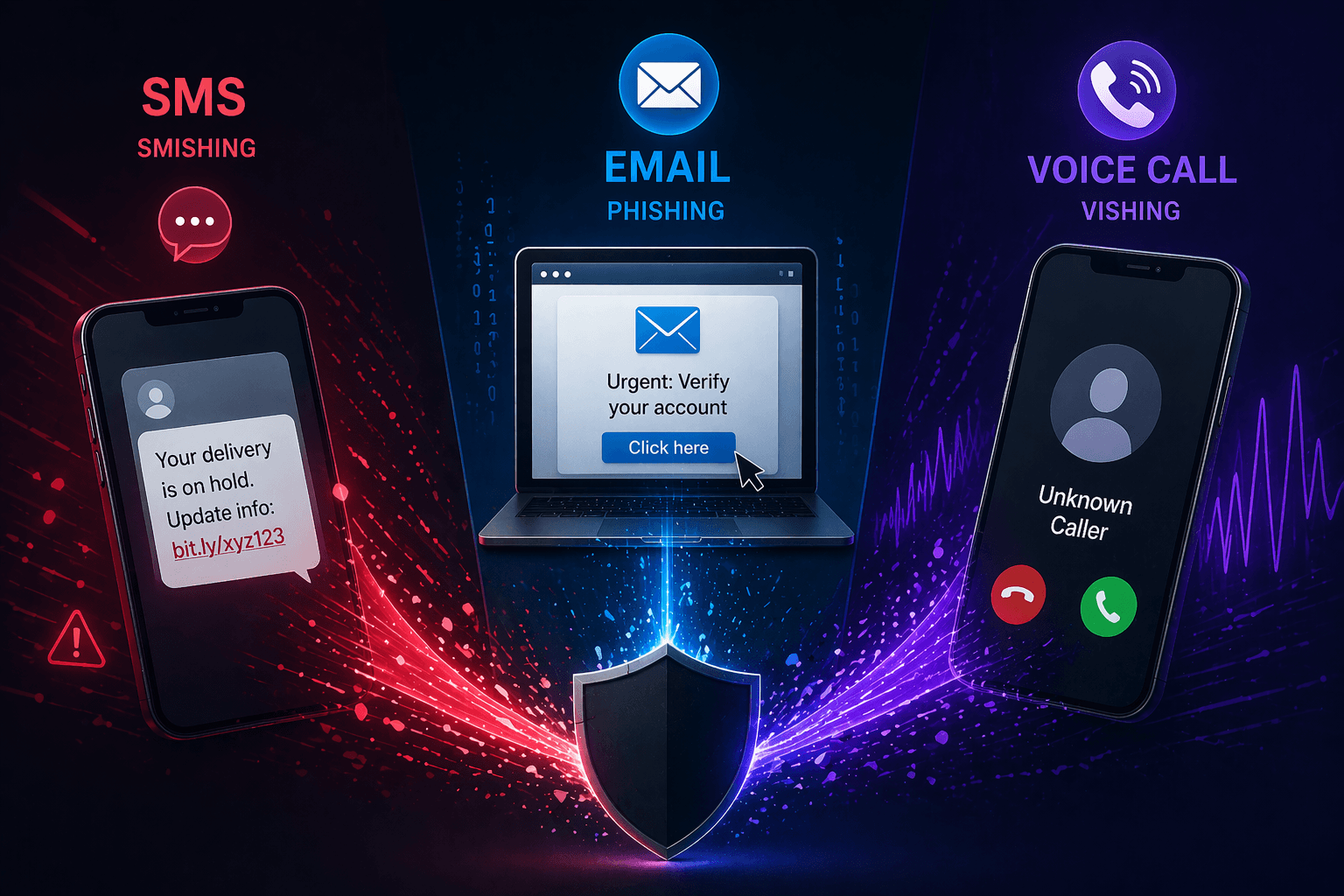
When we talk about phishing, we usually think about email: suspicious links, fake domains, maybe poor grammar, or a logo that looks slightly off. I’m sure we’ve all received a version of the email from someone impersonating your CEO asking for “a quick chat” or “help acquiring gift cards for a customer”. Because they’ve become so common, over time, users have learned to question those signals.
But smishing is different. And that difference is exactly why it’s harder to stop.
To understand why smishing is so hard to detect, it helps to compare the three side by side: phishing (email), vishing (voice), and smishing (SMS). Because the reality is, they don’t just use different channels. They create very different conditions for detection, control, and decision-making.
Why Email Phishing Is Easier to Detect and Filter
Email is still the most common phishing vector, but, perhaps in part due to its popularity, it also has the most mature security ecosystem around it.
At the protocol level, sender identity can be validated using mechanisms like SPF, DKIM, and DMARC. At the infrastructure level, secure email gateways introduce filtering, sandboxing, and policy enforcement before a message ever reaches the user. On top of that, there are layers of inspection such as header analysis, sender reputation, and URL scanning.
Even from the user’s perspective, email provides signals. You can inspect the sender domain, hover over links to see where they lead, and evaluate formatting or tone for inconsistencies.
None of this makes email safe, but it does introduce friction. There are multiple points in the delivery chain where an attack can be detected or disrupted.
Vishing Attacks: Human Interaction Introduces Friction
Voice phishing, or vishing, operates outside those technical controls, but it does introduce a different kind of constraint.
An attacker has to sustain a real-time interaction. That means maintaining a script, responding to questions, and staying consistent throughout the conversation. That process creates opportunities for something to break down, whether it’s tone, logic, or timing.
More importantly, it introduces time. Even a few extra seconds can give a user space to question what’s happening or disengage.
Vishing attacks rose by 442% between the first and second halves of 2024, and kept gaining momentum throughout 2025 for good reason. They’re effective, but still not optimized for speed in the same way as SMS.
Why Smishing Is Hard to Detect
SMS phishing attacks remove both the layered controls of email and the interaction friction of voice, making them much harder to detect.
At a protocol level, there is no reliable way to authenticate the sender. There is no equivalent to SPF, DKIM, or DMARC, so a message arrives as little more than a number or a display name, both of which can be easily manipulated.
There is also no consistent filtering layer that enterprises can rely on. Some carriers attempt spam detection, but it is not standardized, not transparent, and easy for attackers to bypass by rotating numbers and links faster than blocklists can keep up.
Most importantly, SMS does not pass through enterprise-controlled infrastructure. Messages are delivered directly to the user’s device, which means organizations have no opportunity to inspect or block them in transit like they might with corporate emails.
How Smishing Messages Are Engineered for Action
Smishing messages are built differently from phishing emails.
They are extremely short, often just a few lines, and every word is chosen to drive a single action. There is no expectation of context and no room for it. The message doesn’t try to explain, it tells you what to do.
You will typically see a single link, often shortened or slightly obfuscated, paired with a sense of urgency. The attacker only needs one successful interaction, so the entire message is optimized around that moment.
That simplicity works in the attacker’s favor. In email, more content creates more opportunities for something to look wrong. In SMS, there is less to evaluate and less time to evaluate it.
Mobile UX and the Acceleration of Smishing
The mobile experience reinforces this.
There is no hover state to inspect a link before interacting with it. URLs are often truncated, showing only part of the destination. Mobile browsers expose very limited context compared to desktop environments, and there are fewer ways to inspect what is happening behind the scenes.
In many cases, users don’t even open the full message. They act directly from the notification or lock screen, where even less information is visible.
The result is a very compressed interaction model: receive, glance, act.
Trust and Urgency: The Psychology Behind Smishing
On top of the technical limitations, SMS benefits from a high level of built-in trust.
Text messages are commonly used for legitimate, time-sensitive communication. Banks send alerts. Services send verification codes. Healthcare providers send reminders. Users are conditioned to expect short, direct messages that require immediate action.
Attackers replicate that pattern.
They combine a recognizable sender identity with a time-bound threat, such as an account suspension or a failed delivery. Urgency plays a central role here. It short-circuits the decision-making process and pushes the user to act before they have time to evaluate the message.
At that moment, most of the training users receive simply doesn’t apply.
The SMS Visibility Gap in Enterprise Security
Up to this point, the challenge has been about user behavior and attack design. But from an enterprise perspective, the problem runs deeper.
From a security operations perspective, SMS creates a significant blind spot.
In most organizations, email is deeply integrated into the security stack. Messages pass through gateways, are logged, and can be inspected both before and after delivery. If something goes wrong, there is usually a trail to follow.
SMS works very differently.
Messages are delivered directly to the endpoint, often on personal devices, without passing through any enterprise-controlled infrastructure. That means there is no consistent way to inspect messages in transit, apply policy controls, or even know that a malicious message was received in the first place.
In BYOD environments, this becomes even more complex. Organizations typically don’t have the ability to monitor or control native SMS on personal devices, even when those devices have access to corporate data and applications. The result is a channel that sits completely outside traditional security boundaries.
That lack of control is only part of the problem. The bigger issue is visibility.
There is no centralized logging for SMS in most enterprise environments. Message retention is inconsistent, and users frequently delete messages after interacting with them. Once that happens, recovering the original content, timestamps, or sender information can be extremely difficult, if not impossible.
From an incident response perspective, this creates a gap at every stage of the lifecycle.
Detection is limited because there is no reliable way to observe the initial message.
Investigation is constrained because there are few artifacts to analyze.
Response is reactive at best, often relying on user reporting after the fact.
Even when an organization knows a smishing campaign is active, blocking it is challenging. Attackers can rotate phone numbers and domains quickly, often faster than blocklists or carrier-level filtering can keep up. Without a centralized control point, enforcement becomes fragmented and inconsistent.
So the issue is not just that SMS is harder to secure. It’s that it operates outside the systems that security teams depend on for visibility, control, and response.
And without those foundations, even well-established security practices become much harder to apply.
Why SMS Remains the Hardest Channel to Defend
When you look at phishing, vishing, and smishing side by side, the difference is not just the channel. It’s the environment each one creates.
Email provides layers of control and visibility. Voice introduces interaction and time. SMS removes both.
There are fewer signals to evaluate, fewer controls to enforce, and fewer opportunities to intervene. At the same time, the user experience is optimized for speed and immediate action, and the channel itself carries a level of trust that attackers can easily exploit.
That combination makes SMS uniquely difficult to defend.
It’s not just another form of phishing. It’s a channel where both the technical architecture and the way people use it are aligned in the attacker’s favor.
This is the central challenge that a new generation of security must address. Traditional email defenses don’t extend to SMS, and user training alone doesn’t hold up in a mobile-first environment. The only viable path forward is to introduce a new layer of enterprise visibility and control directly into the SMS channel.


Subscribe to our blog to receive the latest research and industry trends delivered straight to your inbox. Our blog content covers sophisticated mobile threats, unpatched vulnerabilities, smishing, and the latest industry news to keep you informed and secure.