
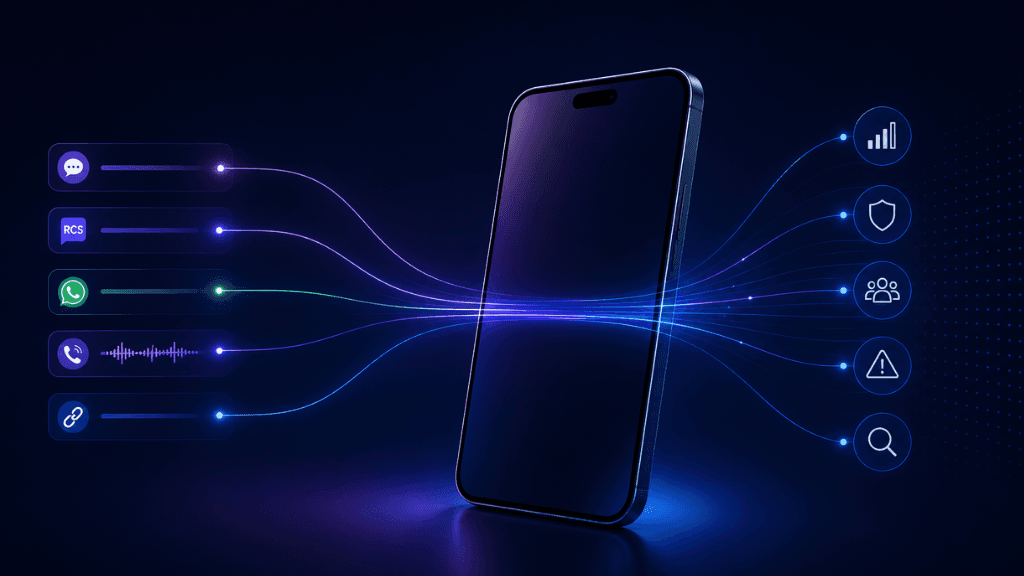
Effective smishing protection requires taking a different approach than most enterprise security tools were designed for.
The challenge is not just identifying known malicious links (in many cases, there are none). It’s detecting intent early enough to prevent a user from engaging with a message in the first place. That means working directly at the message layer, analyzing both what is being sent and how it is being delivered, and making a decision before the interaction begins.
This is the problem SmishGuard, our mobile-native social engineering defense, was built to solve.
Messaging Visibility: The Foundational Data
One of the realities of mobile security is that you don’t get unlimited visibility. On iOS, for example, message analysis is limited to messages from unknown senders. Once a user responds, that conversation moves into a “safe-sender” category that is no longer visible.
Most approaches treat this as a limitation.
SmishGuard treats it as the primary design constraint.
Detection is focused entirely on that first message because that is the only point at which intervention is guaranteed to be possible. If that moment is missed, the rest of the attack chain unfolds outside of any reliable detection layer.
Two Types of Smishing, Two Detection Paths
From a detection perspective, smishing falls into two categories, each requiring a different approach:
Messages that contain URLs
Messages that do not
For messages with URLs, analysis focuses on the destination:
Is the domain newly registered?
Does it impersonate a known brand?
Is it associated with known phishing or credential harvesting infrastructure?
These signals are well understood, can be evaluated quickly, and are often the cornerstone of traditional smishing protection tools. The more difficult problem is the second category. SmishGuard was built to handle both.
Messages without URLs, which are increasingly being used in targeted and enterprise-focused campaigns, cannot be evaluated through traditional threat intelligence or reputation systems. There is no link to inspect or a destination to analyze; instead, detection must focus on the message itself.
Detecting Intent at the First Message
For non-URL-based smishing, the key signal is intent. SmishGuard models are trained on large volumes of real-world smishing data to identify patterns that are designed to trigger interaction:
Messages that create urgency or pressure
Requests that require immediate action
Impersonation attempts
Conversation starters designed to elicit a response
Even something as minimal as a one-word message from an unknown sender can be a high-risk signal, depending on context.
The objective is not to classify every message. It is to identify those most likely to lead to a compromised interaction, even if there is no explicit payload in the initial message.
Why Early Intervention is Critical
One of the defining characteristics of smishing is that the attack often evolves after the first interaction. A user receives a message from an unknown number and responds.
From there:
The attacker gains a trusted communication channel
The conversation can escalate
The attack can move into voice (vishing) or other forms of interaction
At that point, detection becomes almost impossible unless URLs are involved.
SmishGuard intervenes at the earliest stage by identifying high-confidence threats and removing them from the primary message flow. This reduces the likelihood of engagement without disrupting normal communication.
This is not about blocking everything. It is about acting at the point where it has the most impact.
Extending Detection Beyond SMS
Smishing does not exist in isolation. The same infrastructure used to send messages is often used in follow-on attacks, particularly voice-based impersonation attempts.
SmishGuard incorporates feedback loops that allow these signals to be reused:
Numbers associated with high-risk messages can be blocked
Outbound interaction with those numbers can be prevented
Incoming calls from those numbers can be restricted
This extends protection beyond the initial message and reduces the attacker’s ability to continue the interaction through other channels.
Attackers frequently use third-party messaging platforms such as WhatsApp, Signal, or Telegram to initiate or continue attacks. These channels are even harder to monitor, as they operate outside traditional SMS frameworks and, in most cases, beyond what the operating system allows security tools to monitor directly.
To address this, SmishGuard detection can be extended through user-initiated workflows:
Reporting suspicious messages directly from the device
Sharing screenshots for analysis
Extracting message content via OCR for evaluation
Receiving back an almost instant response in the iVerify app so users can choose whether they interact with the message with a much higher degree of safety than before
These approaches allow analysis to be applied consistently across channels, even where direct access is not available.
Closing
Smishing is not a link problem. It’s an interaction problem.
By the time a user engages, the attack has already moved into a channel that most security controls can’t see. That’s why the first message matters.
SmishGuard is built to identify high-risk interactions in real time, before trust is established and before the attack can evolve into something harder to detect and contain. Because at that point, you’re no longer stopping a message. You’re preventing access.
Book a demo to see how SmishGuard closes the mobile gap in your security architecture.


Subscribe to our blog to receive the latest research and industry trends delivered straight to your inbox. Our blog content covers sophisticated mobile threats, unpatched vulnerabilities, smishing, and the latest industry news to keep you informed and secure.