
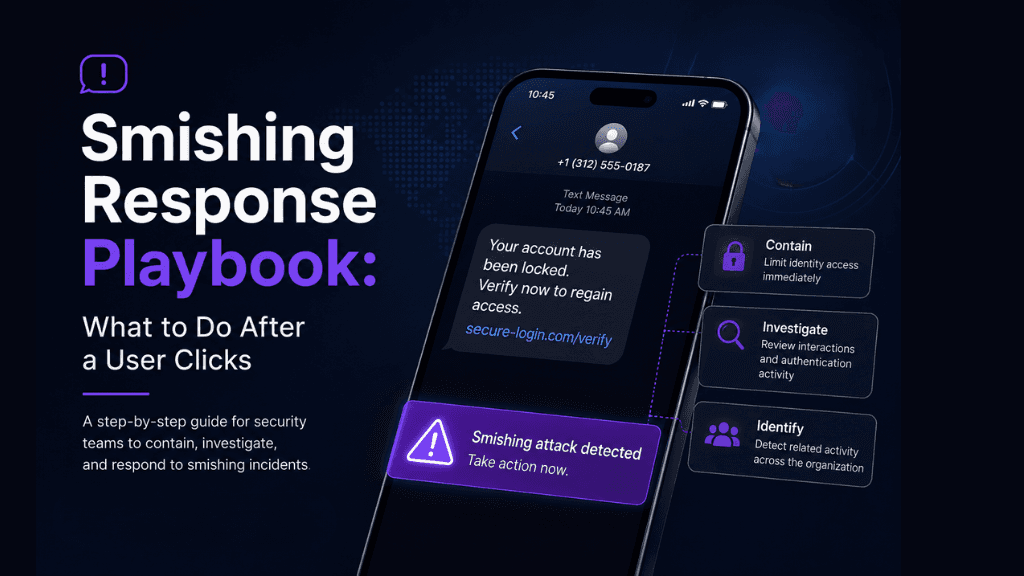
Most organizations already have established workflows for email phishing incidents, but dealing with smishing incidents is different.
SMS-based attacks often occur outside traditional enterprise visibility, on devices that are deeply integrated into authentication and access workflows. Employees can access their e-mail, calendars and messaging app with the entire organization. As a result, during an incident, response becomes significantly more difficult once a user has already interacted with the attack vector: the message.
And because modern smishing attacks increasingly target identity access rather than device infection, the priority after a click is not just protecting the phone itself, it’s containing access to the systems and sessions connected to it.
Step 1: Contain Identity Access Immediately
The first priority after a suspected smishing interaction is limiting authenticated access. If a user entered credentials, approved MFA requests, shared verification codes, or interacted with suspicious login flows, organizations should assume those credentials may already be compromised.
Immediate response actions may include:
Password resets
Session revocation
Invalidating authentication tokens
Reviewing MFA enrollment changes
Forcing reauthentication across critical systems
Reviewing active sessions for unusual access patterns
The goal is to interrupt the attack before compromised credentials or authenticated sessions can be used to move further into the environment. This is especially important on mobile because authentication workflows are often tightly integrated with the device itself.
Step 2: Determine What the User Interacted With
The next step is understanding what actually occurred during the interaction.
Did the user:
Click a link?
Enter credentials?
Download an application?
Respond to the message?
Receive a follow-up phone call?
Share MFA or verification information?
Modern smishing attacks are often multi-stage. The initial SMS may only be the starting point for a broader social engineering flow involving voice calls, identity verification prompts, or conversational engagement over time.
That means the investigation should not focus only on whether a malicious link was opened, but whether the attacker established an ongoing communication channel with the employee.
Step 3: Investigate the Device and Authentication Activity
Unlike email incidents, there is often no centralized record of the original message or the subsequent interaction. SMS messages typically bypass enterprise-controlled infrastructure entirely, and in many environments, there is limited telemetry available from the device itself.
If the user deletes the message, important context may be lost, including:
Sender information
Timestamps
Conversation history
Links or phone numbers used during escalation
At the same time, security teams should review authentication activity associated with the affected accounts, including new login locations, MFA fatigue attempts, suspicious OAuth grants or consent activity, etc.
In many cases, these authentication artifacts become the clearest evidence that compromise has occurred.
Step 4: Identify Broader Campaign Activity
One of the most common mistakes during smishing response is treating the incident as isolated to a single user.
In reality, attackers often target multiple employees simultaneously using:
The same phone numbers
Related domains
Repeated social engineering scripts
Coordinated voice escalation attempts
Understanding campaign scope is critical because attackers frequently move quickly once engagement begins.
Security teams should look for:
Repeated reports involving similar messages
Clusters of MFA-related incidents
Multiple employees contacted by the same sender
Unusual authentication activity across multiple accounts
Patterns of escalation into phone calls or conversational phishing
The challenge is that these correlations are difficult to identify when organizations lack visibility into the mobile messaging layer itself.
Why Traditional Phishing Response Workflows Break Down on Mobile
In contrast to standard phishing response procedures, SMS infrastructure does not provide centralized logging, message archival, or the ability to analyze attachments.
Because messages bypass enterprise oversight by being delivered straight to hardware, visibility is severely limited. Security teams frequently find themselves investigating potential identity theft without having access to the specific communication thread where the breach originated.
Building a Mobile-Native Smishing Response Strategy
As smishing attacks become more conversational and identity-focused, organizations need response capabilities designed specifically for the mobile environment. This requires moving beyond simple URL blocking or user reporting workflows to establish comprehensive visibility into suspicious sender behavior, conversational manipulation patterns, and cross-channel escalations into voice attacks.
This is the shift driving mobile-native approaches like SmishGuard, which extends detection and response directly into SMS and mobile messaging environments. By combining sender intelligence, manipulation pattern analysis, and fleet-level threat propagation, organizations can identify suspicious activity earlier and respond before attacks spread further across the enterprise.
Structured alerts can also integrate directly into existing SIEM/XDR workflows, helping security teams investigate and coordinate response using the same operational processes already used for other enterprise threats.
Smishing Response Requires More Than User Reporting
The challenge with smishing is not just preventing the initial interaction. It is identifying and interrupting the attack before identity compromise spreads further into the organization. That becomes increasingly difficult when organizations lack visibility into the messaging channel itself.
As mobile devices continue to serve as trusted authentication endpoints for enterprise access, smishing response can no longer rely solely on user awareness and manual reporting. It requires visibility, detection, and response capabilities designed specifically for how modern mobile social engineering attacks actually operate.


Subscribe to our blog to receive the latest research and industry trends delivered straight to your inbox. Our blog content covers sophisticated mobile threats, unpatched vulnerabilities, smishing, and the latest industry news to keep you informed and secure.