
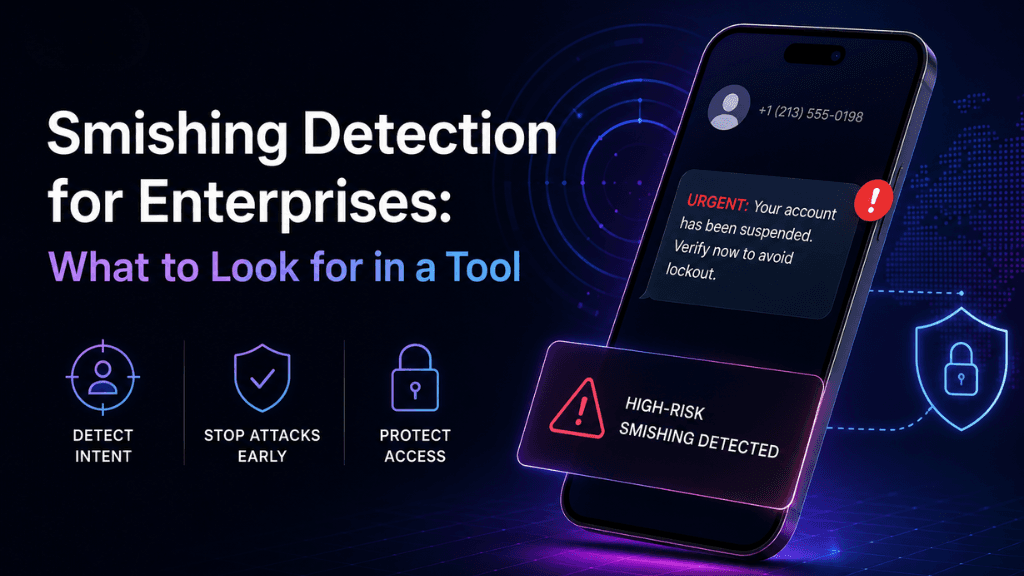
Most organizations evaluating smishing protection start with the same assumption: If we can detect malicious links, we can stop the problem. That assumption is incomplete.
Smishing has evolved beyond simple link-based attacks. In many cases, the link is not the primary mechanism; the interaction is. So the question is not just whether a tool can identify known bad domains; it’s whether it can detect and interrupt the types of interactions that lead to compromise.
That requires a different set of capabilities than most security teams are used to evaluating.
Coverage Needs to Go Beyond URLs
The first thing to consider when evaluating smishing detection tools is the types of messages the tool can detect.
Most solutions perform reasonably well when a message contains a URL. They can evaluate domain reputation, look for known phishing infrastructure, and block obvious threats. But a significant portion of smishing attacks don’t include links at all.
These messages are designed to start a conversation:
A simple “hello” message from an unknown sender
A request to reply or take an action
If detection relies solely on URLs, these attacks will go undetected. Instead, a viable smishing solution needs to handle both:
URL-based smishing
Non-URL, interaction-driven attacks
Detection Should Focus on Intent, Not Just Indicators
Traditional detection models rely on known indicators, like domains, payloads, and patterns. That approach works for repeatable attacks, but it struggles with variations designed to bypass those indicators.
Smishing campaigns are often built around human behavior rather than technical artifacts, using urgency, pressure, and familiarity to drive action.
That means detection needs to evaluate intent:
Is the message trying to trigger a rapid response?
Is it impersonating a trusted entity?
Is it structured to initiate interaction?
These are the signals that determine whether an attack is likely to succeed. If your smishing detection tool only focuses on static indicators, it will miss a large portion of these messages.
Timing Matters More Than Most Teams Realize
Smishing is not just about what the message contains. It’s about when detection happens.
If a user has already interacted with a message, the attack has often moved beyond the point where it can be controlled.
On some platforms, once a user responds to a message from an unknown sender, that conversation becomes trusted and is no longer visible for analysis.
At that point:
The attacker can continue the interaction
Escalate the conversation
Move into voice or other channels
A tool that detects threats after engagement is already behind. Effective smishing protection relies on detection happening at the first message, before the user has a chance to respond.
Look for Coverage Across the Attack Chain
Smishing rarely exists in isolation and, in many cases, often leads to other forms of attack:
A message leads to a conversation
The conversation leads to a phone call
The phone call leads to credential compromise
Many tools stop at identifying the initial message, leaving the rest of the attack chain unaddressed.
A more complete approach includes:
Identifying high-risk messages
Blocking or flagging the associated numbers
Preventing further interaction across messaging and voice
This kind of feedback loop is critical. Without it, attackers can continue using the same infrastructure to reach users through different channels.
Integration With Identity and Access Controls
Smishing is fundamentally an identity problem. The objective is not to infect the device; it’s to gain access. Because of that, detection needs to integrate with the systems that control access:
Conditional access platforms
Identity providers
Session and token management
If a high-risk interaction is detected, that signal should be able to trigger:
Access restrictions
Session termination
Credential resets
Without integration, detection becomes informational rather than actionable.
Privacy Constraints Should Be Built In
Any solution operating at the message layer has to address privacy. This is especially important in BYOD environments, where personal and corporate use coexist.
Key questions to ask:
What messages are visible to the system?
What data is stored?
What can administrators access?
A well-designed solution will:
Limit visibility to high-risk entry points (such as unknown senders)
Avoid storing benign or safe messages
Restrict administrative access to relevant security events only
If a tool requires broad access to user communications to function, adoption will be difficult, and risk may shift rather than decrease.
Deployment Should Be Low Friction
Operational complexity is often overlooked during evaluation.
A solution that requires extensive configuration or ongoing user interaction will struggle to achieve coverage at scale, so it’s important to look for:
Integration with existing mobile deployment methods (MDM, low-touch provisioning)
Minimal required user actions
Clear guidance for any necessary configuration steps
The goal is to ensure that protection is consistently enabled across the device fleet, not just for a subset of users.
Measuring Impact and ROI
Smishing detection is often evaluated differently from traditional security controls because the impact is not always visible in daily operations. The real impact shows up in what doesn’t happen.
A useful way to measure ROI of your smishing protection tool is to look at past incidents:
How many originated from mobile interactions?
What was the cost of those incidents?
Could earlier detection have prevented them?
Preventing even a small number of these attacks can justify the investment, particularly when they lead to credential compromise or broader access issues.
How iVerify’s SmishGuard Approaches Smishing Detection
SmishGuard was designed around the same challenges outlined above.
Rather than focusing only on known indicators like URLs, it is built to detect both link-based and interaction-driven smishing. That includes identifying high-risk messages at the point of first contact, before a user has the opportunity to engage.
Detection models are trained to evaluate intent, not just artifacts. That means analyzing how a message is structured, whether it is attempting to create urgency, or whether it is designed to initiate a conversation that leads to compromise.
From there, protection extends beyond the initial message:
Suspicious messages can be flagged or moved out of the primary inbox
Associated numbers can be blocked to prevent follow-on interaction
Signals can be used to inform broader security controls
At the same time, the system is designed to operate within strict privacy boundaries. Visibility is limited, benign messages are not retained, and administrative access is restricted to high-risk events.
The goal is not to monitor user communication. It is to intervene at the point where risk is highest, without expanding beyond what is necessary.
See How SmishGuard Works in Practice
Understanding how smishing detection works in theory is one thing. Seeing how it performs in a real environment is another.
If you’re evaluating how to close the SMS and messaging gap in your security architecture, it’s worth examining how these capabilities operate on actual devices and in real-world messages.


Subscribe to our blog to receive the latest research and industry trends delivered straight to your inbox. Our blog content covers sophisticated mobile threats, unpatched vulnerabilities, smishing, and the latest industry news to keep you informed and secure.