
Modern mobile attacks have outpaced the security models built to catch them. Legacy approaches focused on obvious signals: malicious apps, rooted devices, unauthorized software, and policy violations. Those threats still exist, but they no longer define the full landscape of mobile risk.
Today's most sophisticated attackers rarely trigger the indicators security teams were trained to look for. Instead of deploying visible malware or tampering with the OS in detectable ways, they operate through stealthy execution, trusted system services, and legitimate applications. Credential theft, session hijacking, MFA abuse, and mobile-focused social engineering succeed by exploiting trusted access, often without ever touching the device in a traditional sense.
This creates an environment where conventional indicators of compromise are far less reliable.
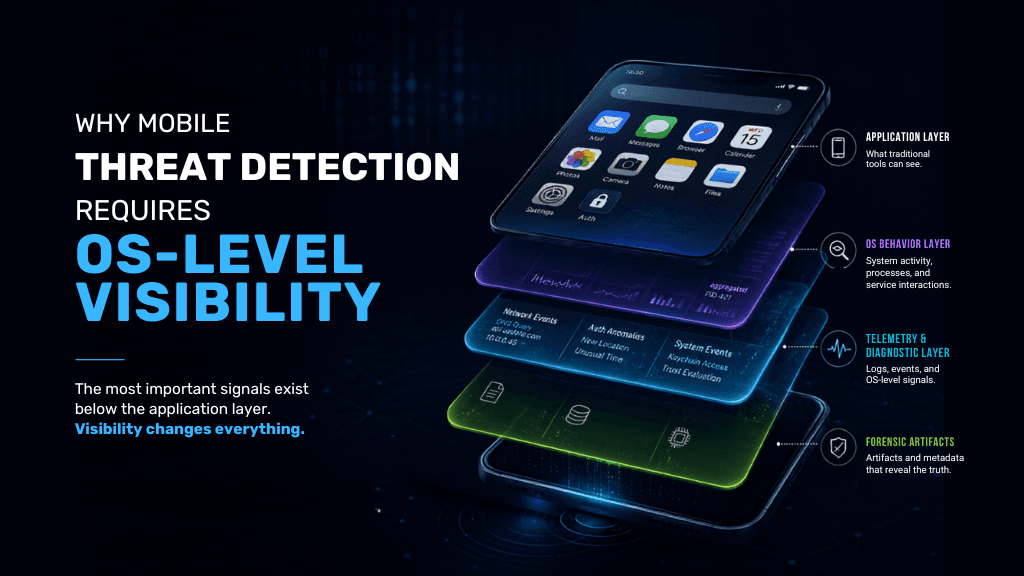
The Most Important Signals Often Exist Below the Application Layer
Modern mobile attacks often leave their most important traces outside the places traditional security tools are designed to inspect.
Instead of appearing as a clearly malicious app or a visible policy violation, compromise may show up through subtle changes in system behavior: unusual process activity, suspicious service interactions, diagnostic artifacts, authentication anomalies, or abnormal operating system events.
Individually, these signals may appear insignificant. Collectively, they can reveal evidence of compromise that would otherwise remain invisible.
This is compounded by a fundamental limitation of mobile operating systems: they expose far less telemetry than traditional desktop environments. Unlike laptops or servers, smartphones weren't designed to give enterprises deep forensic visibility by default. That leaves organizations with limited insight into exactly the areas where sophisticated mobile attacks are most likely to occur.
iVerify Enterprise is built around this reality. Rather than relying on device posture, app reputation, or policy compliance alone, it continuously monitors iOS and Android devices for behavioral anomalies, indicators of compromise, diagnostic telemetry, process metadata, and low-level OS signals — the subtle artifacts modern attacks actually leave behind.
By analyzing these signals over time, iVerify Enterprise helps security teams identify suspicious activity that would otherwise remain invisible to traditional security controls.
What This Means for Incident Response
OS-level visibility becomes especially critical in scenarios involving zero-click exploitation, fileless spyware, advanced surveillance tooling, and identity abuse. In these cases, there may be no malicious file to inspect, no suspicious app to remove, no obvious user action to trace. The evidence exists only in forensic artifacts, process behavior, and diagnostic telemetry.
This is where forensic investigation becomes critical. When suspicious activity is identified, security teams need access to the diagnostic artifacts, telemetry, logs, and process metadata that help validate findings and determine what actually happened.
Threat Hunter IR is purpose-built for this stage of the process. It retrieves and securely packages OS-level forensic data from iOS and Android devices, giving investigators the evidence needed to examine suspicious activity, understand incident scope, and support response efforts.
When used together, iVerify Enterprise provides continuous visibility into potential threats, while Threat Hunter IR delivers the forensic depth needed to investigate them with confidence.
Mobile Belongs Inside Enterprise Detection and Response
For a long time, mobile operated in a silo, separate from the endpoint, cloud, network, and identity visibility that drove core security operations. That separation is no longer defensible.
Smartphones are now authentication infrastructure, communication platforms, cloud access gateways, and persistent enterprise access points. A compromised mobile device isn't just a mobility problem; it's a direct threat to enterprise identity, cloud security, and operational resilience. Mobile telemetry needs to be part of broader detection and response workflows, not a standalone compliance initiative.
Closing the Visibility Gap
Attackers understand how to move quietly within mobile environments: abusing trusted sessions, blending into legitimate processes, staying below the threshold of conventional detection. Most organizations still have less visibility into mobile activity than they do across the rest of their stack. That imbalance is one of the most exploitable gaps in modern enterprise security.
Device management and compliance enforcement remain important, but they're not sufficient on their own. Effective mobile threat detection depends on OS telemetry, behavioral signals, and continuous visibility into device activity. When suspicious behavior is identified, forensic artifacts provide the evidence needed to validate findings and support incident response.
iVerify helps security teams bring both continuous mobile threat detection and forensic investigation capabilities to iOS and Android devices without turning mobile security into invasive device monitoring.
iVerify Enterprise helps security teams identify suspicious activity. Threat Hunter IR provides the forensic evidence needed to understand what happened.
Because you can't defend against threats you can't see, and you can't investigate incidents without the data to prove they occurred.


Subscribe to our blog to receive the latest research and industry trends delivered straight to your inbox. Our blog content covers sophisticated mobile threats, unpatched vulnerabilities, smishing, and the latest industry news to keep you informed and secure.