
I’ll start with an observation that’s become more obvious over time.
Mobile devices are now one of the most important computing platforms in the enterprise. They sit at the center of how people work, communicate, authenticate, and access critical systems. And yet, from a security perspective, we still treat them like an afterthought. That disconnect is where the problem starts.
The mental model hasn’t caught up
If you look at how most organizations think about endpoints, the model is still anchored in a world of laptops and desktops. That’s where the tooling is mature, visibility is expected, and security teams feel they have some level of control.
Mobile never really went through that same evolution. Early on, it was positioned as the safer environment with sandboxed apps, curated app stores, and locked-down operating systems. Compared to traditional endpoints, it felt constrained in a way that worked in our favor. Over time, that led to a quiet but persistent assumption that mobile was simply lower risk.
The problem is that assumption hasn’t aged well.
Mobile didn’t stay simple
The role of the mobile device has changed dramatically, even if our perception of it hasn’t.
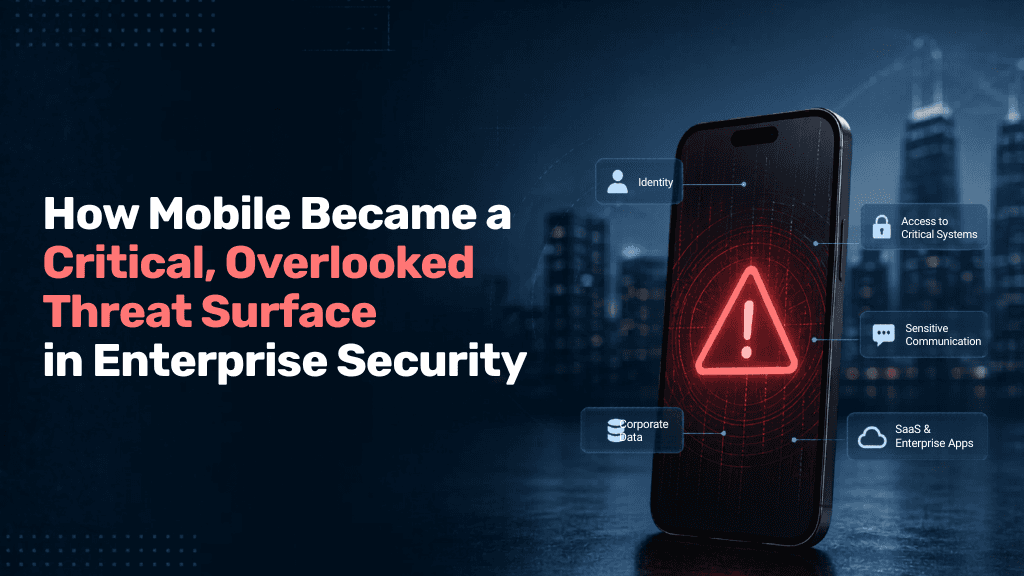
Phones are now used for authentication into critical systems, serve as the primary channel for sensitive communication, and often act as the front door into SaaS environments. Whether intended or not, they also end up holding corporate data.
In other words, they are no longer peripheral devices. They are central to identity and access. If you were designing an attack surface from scratch, you would probably end up with something that looks a lot like the modern smartphone. It’s always connected, always on, deeply trusted, and tightly integrated into the workflows that matter most.
That’s not something attackers have overlooked.
Trust is doing a lot of heavy lifting
One of the more subtle issues with mobile is the level of implicit trust users place in it.
People are more likely to trust a message on their phone than an email in their inbox. They tend to act more quickly and question context less. Part of that is historical. Banks, healthcare providers, and government services have trained users to expect legitimate communication over SMS and mobile apps, and over time, that builds a baseline of credibility.
From an attacker’s perspective, that trust is incredibly useful. It shortens the path from initial contact to action, and because the interaction occurs on a personal device outside traditional corporate controls, it often happens without much scrutiny.
Visibility is still a major gap
If you talk to most security teams, they’ll tell you they have strong coverage across traditional endpoints. They can see process activity, network connections, and suspicious behavior. They can investigate and respond with a reasonable degree of confidence.
Ask the same questions about mobile, and the answers are very different. What can you actually see on a device? What telemetry do you have access to? How quickly can you detect something that doesn’t look right?
In many cases, the honest answer is not much. That lack of visibility creates a blind spot that is easy to underestimate, not because the risk is theoretical, but because it’s difficult to observe and quantify in the same way teams are used to.
The threat isn’t hypothetical anymore
For a long time, mobile threats were easy to dismiss. They were either highly targeted or technically complex, or both. Something that existed, but didn’t feel like a day-to-day concern for most organizations.
That’s changed.
The barrier to entry has come down, attack techniques have become more accessible, and the value of compromising a mobile device has gone up, particularly as it becomes more tightly linked to identity.
You no longer need a nation-state-level capability to create meaningful impact. In many cases, you just need to get a user to take a single action on a device they already trust, creating a very different risk profile than what most teams are planning for.
We’re still solving the wrong problem
Many current approaches to mobile security are built around management and compliance. Is the device enrolled? Is it running the right OS version? Are certain policies enforced?
Those are useful questions, but they don’t get to the core issue. They don’t tell you if a device is compromised, if a user has been manipulated, or if sensitive data is being exposed through legitimate-looking activity.
In other words, they don’t address how mobile devices are actually used and abused today.
A shift in perspective is overdue
None of this is to say that mobile is uniquely insecure. It isn’t. But it is uniquely misunderstood.
We’ve carried forward a set of assumptions from an earlier version of the ecosystem into a very different reality. The technology has evolved, the role of the device has expanded, and the threat landscape has adapted. Our mental model hasn’t kept pace.
Until it does, mobile will remain a blind spot, sitting right in the middle of the enterprise, not at the edge. And that’s exactly why it’s worth paying attention to now.


Subscribe to our blog to receive the latest research and industry trends delivered straight to your inbox. Our blog content covers sophisticated mobile threats, unpatched vulnerabilities, smishing, and the latest industry news to keep you informed and secure.