
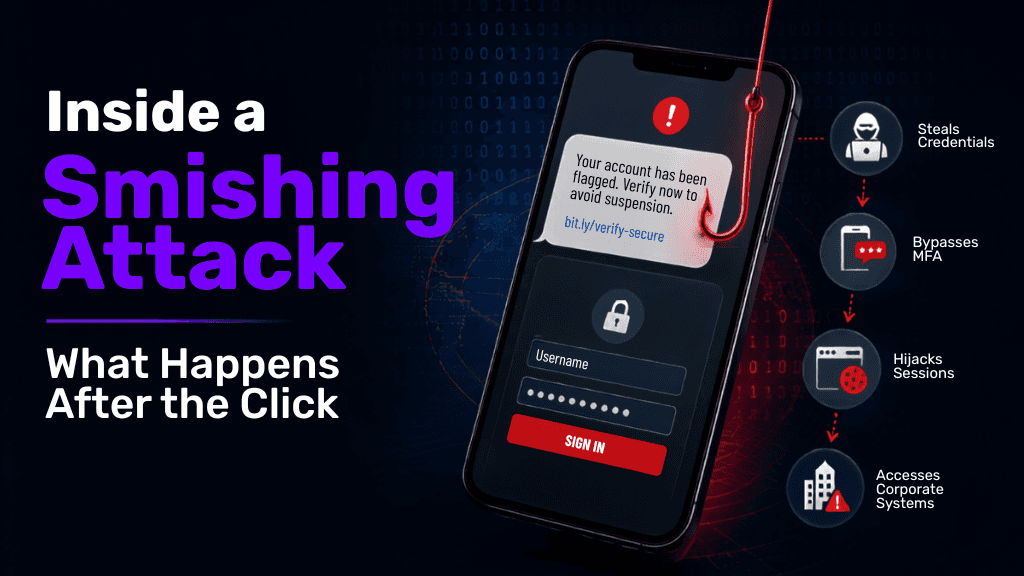
Modern smishing attacks are rarely just about delivering malware to a device. In enterprise environments, the real objective is usually identity access: credentials, authenticated sessions, MFA verification codes, and access to the systems employees already trust and use every day.
That distinction matters because the impact of a smishing attack is often far larger than the initial interaction itself. We are moving away from a narrative of long (and secure) passwords to having mobile devices deeply integrated into authentication and access workflows. At many organizations, employees use phones for MFA approvals, password resets, SSO authentication, corporate messaging, and access to cloud applications.
Let’s dive into what happens in a smishing attack and understand how these old methods are still successful:
Step 1: It all starts with Credential Harvesting
In the world of cyberattacks, it is critical to begin with some form of identity verification or credential collection.
Attackers can send a shortened, but authentic-looking URL to a phone. This is how they leverage the trust we have put on text messaging, and after the user taps a link, they may be directed to a fake login portal designed to impersonate legitimate organizational tools.
It is worth mentioning that these pages are typically optimized for mobile and intentionally minimal. They’ll load fast and convince the user to authenticate normally.
In many cases, the attacker is not relying on malware at all. They are relying on the user voluntarily entering credentials into an environment that appears trusted.
Step 2: Cracking the MFA trust, interception and Session Theft
There is an increasing blind trust on MFA, and many security teams expected it to stop credential theft. At iVerify, we are seeing the shift in modern smishing campaigns to work around this assumption.
Some attacks use real-time phishing infrastructure that immediately relays credentials to the legitimate service and prompts the user for MFA verification codes. They are just standing in the middle of the entire workflow and collecting the credentials before the user realizes what is happening. If they ever do.
In other cases, the goal is not even MFA collection itself, but session theft. Once the user authenticates, attackers may capture session tokens or hijack authenticated browser sessions, allowing them to bypass MFA entirely.
At that point, the attacker is no longer operating as an external threat. They are operating inside an authenticated user session.
Step 3: Escalating the attack beyond the phone
Take a moment to think of all the services you have access to from your phone, not just personal, but also corporate. Attackers only need to establish identity access to quickly move beyond the mobile device itself.
From there, the compromise can expand into additional social engineering, lateral movement, or business process abuse. This can often go undetected for days and one of the reasons smishing is so effective in enterprise environments. Our phones are connected directly to authentication systems, communication platforms, and identity workflows, becoming a highly valuable target for criminals.
Why Mobile Attacks Evade Detection and Investigation
To answer that question, we need to understand that one of the biggest challenges with smishing detection lies in a significant operational blind spot: many enterprises lack oversight of mobile devices that possess extensive access to corporate environments and act as primary entry points for authorized users.
Unlike email, SMS messages typically do not pass through enterprise-controlled infrastructure. There may be no centralized logging, limited message retention, and very few artifacts available for investigation.
At the same time, attackers can quickly rotate phone numbers, domains, and infrastructure, making campaigns difficult to correlate across users. This creates a situation in which organizations often respond to identity compromise without clear visibility into how the compromise began.
Early Detection Matters
The earlier a smishing attack is identified, the more opportunities organizations have to interrupt the attack chain before identity compromise occurs. That means detection can no longer rely solely on known malicious URLs or user-reported incidents after the fact.
This is the shift driving mobile-native approaches like iVerify’s SmishGuard. As part of our Enterprise EDR platform, our approach is to extend visibility and detection directly into the mobile messaging layer itself.
Security teams and SOCs can leverage the sender intelligence, manipulation pattern analysis, and fleet-level threat propagation. At the same time, it allows the end user to be proactive in the cybersecurity defense of their organization.
In modern enterprise environments, organizations can no longer treat smishing as just another phishing problem. Smishing is stripped from the need to use graphics, HTML code and elaborated social engineering, all it needs is a short URL and a target willing to tap it.


Subscribe to our blog to receive the latest research and industry trends delivered straight to your inbox. Our blog content covers sophisticated mobile threats, unpatched vulnerabilities, smishing, and the latest industry news to keep you informed and secure.