
Mobile devices sit at the center of how we work. They’re how we authenticate, how we communicate, and often how we access the systems that matter most.
That much is widely understood.
What’s less examined is the level of trust we place in those devices, and how little that trust has been questioned as the role of mobile has evolved.
Trust wasn’t accidental
The way people interact with mobile devices today didn’t happen by chance. It was shaped over time.
Early on, mobile platforms were positioned as more controlled environments. App stores were curated, operating systems were locked down, and the overall experience felt more constrained than traditional endpoints, creating a sense of safety.
At the same time, legitimate institutions reinforced that perception. Banks sent one-time passcodes. Healthcare providers sent appointment reminders. Government services use SMS for notifications and alerts.
Over time, those interactions trained users to associate mobile communication with legitimacy. If something showed up on your phone, it was more likely to be real, or at least more likely to be trusted.
That baseline hasn’t really changed, even though the environment around it has.
The device feels personal, not corporate
There’s another dynamic at play as well. Mobile devices are personal in a way laptops often aren’t.
People carry them everywhere. They use them for both personal and professional activity, often without a clear boundary between the two. That creates a different kind of relationship with the device, one that feels more familiar and less guarded.
From a security perspective, that matters.
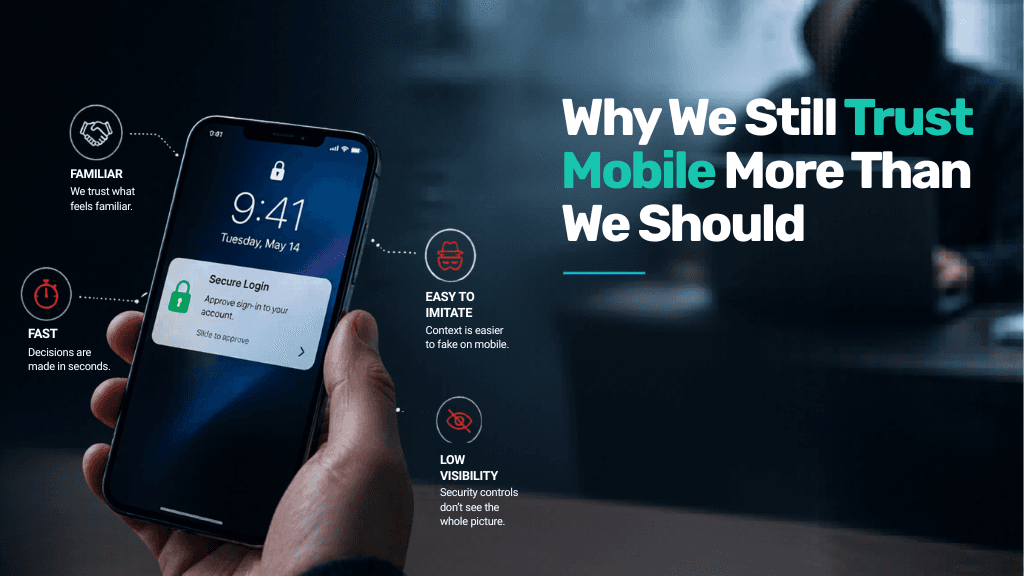
Users tend to be more cautious on systems they perceive as “work devices.” They expect monitoring, controls, and restrictions. On mobile, those expectations are lower. Interactions feel more immediate and less formal, and decisions are made more quickly.
That combination of familiarity and speed creates an environment where small moments of friction or hesitation are less likely to occur.
Context is easier to simulate
Another reason mobile is so effective as an attack surface is that context is easier to replicate.
On a desktop, there are often multiple signals a user can rely on. They can inspect URLs more easily, cross-check information, or move between tools to validate something before acting.
On mobile, those signals are reduced. Screen size limits visibility. Interfaces simplify information. Actions are compressed into a few taps.
That doesn’t just make things more convenient. It also makes it easier for an attacker to present something that looks and feels legitimate, without needing to perfectly replicate every detail. When you combine that with the existing trust users place in their devices, the threshold for taking action drops significantly.
Speed works against us
Mobile interactions are designed to be fast. Notifications prompt immediate attention. Messages are read and responded to quickly. Authentication flows are built to reduce friction as much as possible.
All of that is good for usability, but it changes how decisions are made.
On a laptop, there’s often a natural pause. On mobile, that pause is compressed or removed entirely. The expectation is that you’ll act in the moment, and for an attacker, that’s valuable. It reduces the time a user spends questioning what they’re seeing and increases the likelihood of immediate action.
In many cases, that’s all that’s needed.
Security controls don’t follow the user
Even when organizations have strong security controls in place, those controls don’t always extend effectively to mobile interactions.
A user might receive a message on their phone, take an action, and then move into a corporate environment that appears fully trusted. From the system’s perspective, everything looks normal. The authentication is valid, the device appears legitimate, and the activity fits expected patterns.
What’s missing is the context of how that action started.
That gap between the initial interaction and the downstream activity is where most of the risk lies. And it’s a gap that many existing controls aren’t designed to close.
The result is a false sense of security
When you put all of this together, you end up with an environment that feels safer than it actually is.
The device is trusted. The interactions feel familiar. The controls appear to be working. From the outside, everything looks consistent with how users are expected to behave.
But underneath that, the assumptions are outdated.
We’re relying on signals that were shaped in a very different version of the mobile ecosystem. We’re trusting interactions that are easier to manipulate than they appear. And we’re making decisions quickly in environments with limited visibility.
That combination creates a false sense of security, one that’s difficult to challenge because it’s built into how people naturally use their devices.
What this means in practice
None of this is theoretical. It shows up in very practical ways.
It shows up in how quickly users act on messages they receive on their phones. It shows up in how easily context can be mimicked. And it shows up in how little visibility most teams have into those interactions.
The important point is not that users are making poor decisions. It’s that the environment is designed in a way that makes those decisions more likely.
Until that changes, the gap between how mobile is used and how it’s secured will continue to widen. And that’s where the next set of problems starts.


Subscribe to our blog to receive the latest research and industry trends delivered straight to your inbox. Our blog content covers sophisticated mobile threats, unpatched vulnerabilities, smishing, and the latest industry news to keep you informed and secure.